
For my first blog post in quite a while, I’ve chosen a topic that goes back to the beginning of civilization: the humble wheel. (Apologies to the Incas, who kinda missed out on this whole thing.) The wheel goes round and round, especially on the bus, and helps civilized humans to carry stuff from here to there with the greatest of ease. Or at least, greater ease than dragging that 100-lb sack of donkey feed.
My usual purview is model railroading, which is the art of moving… well, nothing critical… from point A to loop B using a small train– and it turns out that small trains require a lot of wheels. Big wheels, small wheels, plastic wheels, metal wheels. Lots and lots of them. Even the big trains, which we’re emulating after all, have lots of great big steel wheels (and track detectors that count them as they go buy; get yourself a scanner and have a listen). Railroad wheels come in pairs, connected by a rigid axle at a standard width. Real railroad wheels have bearings to reduce friction, model ones use a different method– and this gets us to the point (ahem) of this post.
As it happens, the usual design for model wheels consists of a frame (the “truck”) made of some slippery plastic with a pit molded into the inside faces. The axles have a sharp point on each end, beveled to 60-degrees by NMRA standard, and these points pop into the aforementioned pits. The pointy ends reduce friction to a minimum, or so goes the theory.
The problem is, there are a few variables which increase friction. The truck sideframes can be too tight; the axles can be too long; the materials can be too soft; the porridge can be too cold. Lots of things. If you have a badly-rolling truck, the cause of friction will suggest a remedy or two. For instance, powdered graphite dusted into the bearing is often used. Sometimes the truck frames can be carefully spread apart. There’s even a tool that will precisely ream out the pits and make the axles spin freely. And for those hopeless, or hopelessly-frustrating situations, one can always purchase some quality wheelsets and replace the whole shebang.

Now we’ll get down to cases. I got started on this due to a couple of performance issues with my rolling stock. First, I have several 89-foot cars by Accurail, mostly piggyback flats and an open autorack of the same basic foundation. These have been performance headaches for years– I even wrote a blog about it a while ago. I tried graphite but it wasn’t really solving it. That’s when I noticed that the stock trucks actually have plastic wheelsets– axles as well as the wheels! There’s gotta be a better way, I told myself. I rummaged around and found some surplus wheels with brass axles, replaced the plastic wheels, and dang if it didn’t make a massive improvement! These weren’t expensive metal wheels, but the metal axle points really helped the cars roll. The wheelsets I installed were extras from Walthers cars. Stand by for the irony, coming to a paragraph right after this one.
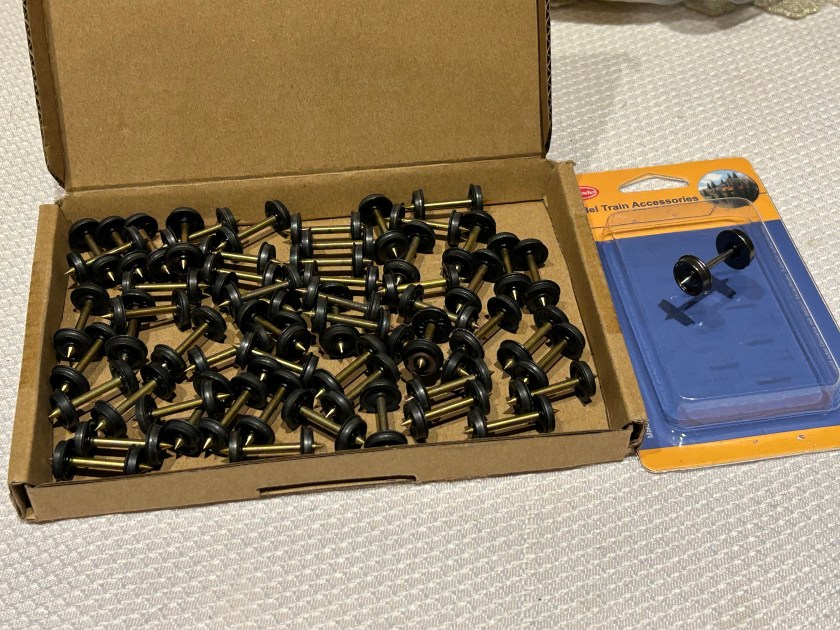
The second issue I’ve been having– forever, that is– is with my fleet of Walthers 100-ton quad coal hoppers. They just won’t stay railed consistently. They all have the exact same wheels I put onto the Accurail flats, but for whatever reason they are a bit tight. In fact, I bet the trucks are actually too tight for the axles. At any rate, I decided I really wanted to improve performance. So, rather than spend $10/car on new trucks, I ordered a bunch of packages of metal wheelsets, hoping they’d fit and work well. The ones I chose are by a company called Evemodel, and they are all-metal, insulated, and blackened, for a decent price per unit. (Buying 5 packs from an ebay vendor really cut down the pro rata shipping charge.) A week later the package arrived, I installed a few, and MAN what an improvement! I got enough to outfit the entire unit train; I test-ran it up my 2% grade, and the locomotives actually wrote me a nice letter saying how much they appreciated the reduction in their workload! I was touched.
A little aside here: the Evemodel people seem to subscribe to the Baker’s Dozen concept. Each and every package of 12 wheelsets contained… 13. I thought I was seeing things. Nope. Thirteen in every pack. If you do some quick math, if you bought four packages, then there’s enough surplus axles to upgrade an additional car (because a car has four axles, right?) I bought five packs so I have one stray axle.
Another aside, rather important: before ordering, I researched what size wheel was correct for my coal hoppers. Being 100-ton cars, they needed 36″ wheels, so I bought that. While replacing the wheels, I discovered that the original Walthers wheels were only 33 inches! The FRA and all the government regs mandate 33″ wheels on up to 70 tons, but 36″ on anything heavier. Those B-words at Walthers put the wrong wheels in all these kits! (The now-surplus 33″ wheels I removed from the quads are actually fine for piggyback flats, so that part worked out OK.)

To summarize:
• The stock Walthers wheels were wrong size and possibly wrong fit in the Walthers trucks. But the Evemodel metal wheels work great in the Walthers trucks.
• The stock Accurail wheels are crap, basically, but the Walthers wheels that don’t work well in Walthers trucks actually work fantastic in the Accurail trucks. Go figure.
Atlas and Walthers make aftermarket trucks with metal wheels, but it gets expensive fast. These metal wheelsets were a good compromise solution and I’m thrilled at the result. Oh, and they’re all in gauge too.
You don’t have to reinvent the wheel. Sometimes you just replace it instead.


